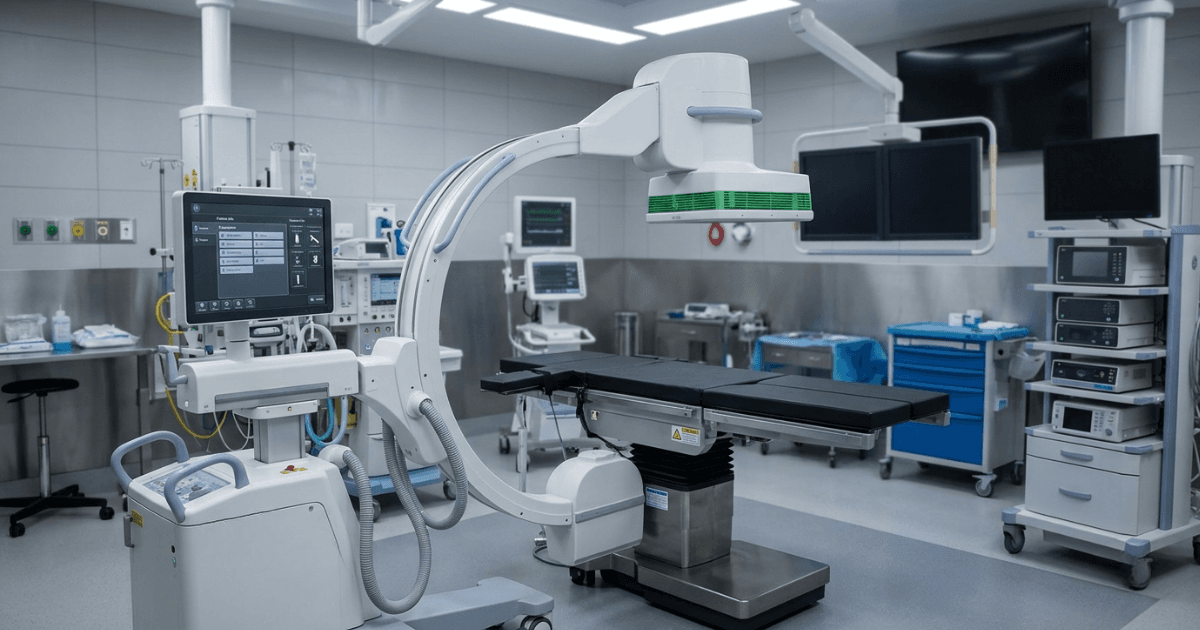
A new C-arm runs up to $200,000. A surgical robot runs into the millions. The data that justifies the purchase is the same data that tells you whether you need it at all.
Every capital request lands on the same desk with the same question attached. Do we actually need this, or do we only think we do? A new C-arm is a $70,000 to $200,000 decision. A surgical robot is a seven-figure one. The case for either usually rests on the one thing the OR rarely measures with any precision: how hard the equipment already in the building is working.
So the request gets built on impression. The C-arm is always booked. Surgeons are waiting on it. Two services keep colliding over the same room. Each of those statements may be true. None of them is a number, and a number is what leadership signs against.
The Most Expensive Guess in the Budget
A capital decision made without utilization data can miss in either direction, and both misses are expensive.
Buy equipment you did not need, and the capital sits in a room at low utilization while depreciation, the service contract, and the floor space all keep billing. A surgical robot carries an annual service fee well into six figures before a single case runs on it. That is real money committed against a shortage that may have been a scheduling artifact.
Decline equipment you genuinely needed, and the cost arrives the other way. First cases wait on a shared C-arm. Cases get bumped to another day. The high-volume surgeon who cannot get reliable access to the tool starts moving cases to a facility that can offer it. The capital you saved is dwarfed by the volume you lose.
Both misses come from the same place. The people making these calls work from what they can see, and equipment utilization is usually the part of the OR no one is measuring.
Eighty Percent Is the Number That Settles It
There is a widely used benchmark for whether a surgical resource is fully used. A well-utilized OR runs near 80 percent of its available time. Most US health systems sit between 65 and 75 percent, and the gap between that range and the benchmark is the single largest pool of recoverable capacity in surgical operations.1
The same threshold applies to the capital inside the room. When a piece of equipment is consistently at or above 80 percent utilization, you have genuinely run out of it, and adding capacity is justified on the numbers. When it sits below that line, you are carrying slack, and the access problem your surgeons describe is more often a scheduling issue than a true shortage. The 80 percent line turns a subjective debate into an objective test. Either the equipment clears it or it does not.
What the Data Shows That Instinct Misses
The value of measuring utilization is that the answer is frequently not the one anyone expected.
A C-arm that everyone agrees is overbooked turns out to run at 55 percent, with the perceived shortage concentrated in a single overlapping window two services both want. The answer there is a schedule change, and the capital request quietly disappears. Another facility measures the same way and finds its robot running at 85 percent across the week, which converts a contested request into a documented case leadership can approve without debate. Both answers save money. One avoids a seven-figure purchase that was never warranted. The other arms a real request with the ROI justification that gets it signed.
Measured consistently, utilization data also surfaces patterns that no single day reveals. Certain equipment turns out to be double-booked across rooms while an identical unit sits idle two ORs away. Gaps cluster around specific case types or times of day. Demand that looked like a shortage looks, on the data, like a distribution problem. These are the insights that reshape how next quarter gets planned, and they come from a record of how the equipment is actually used rather than a request form or a hallway conversation.
How Caresyntax Helps
Caresyntax captures equipment utilization automatically, from the video and device signals already moving through the OR. Through Caresyntax ORI, the platform sees which capital equipment is in use through video and transcoder activity, with nothing to log by hand. ORION analytics turns that capture into a clear record of how often each piece of equipment runs, broken down by room, by service line, and by time of day.
For the Director of Perioperative Services, that record is the difference between a capital request built on impression and one built on evidence. You can show leadership exactly where utilization sits against the 80 percent benchmark, justify the equipment that has earned its place on the floor, and redirect the requests the schedule can absorb instead. The capital conversation stops being about who is asking loudest and starts being about what the equipment is doing.
When utilization is measured, every capital decision that depends on it gets easier to make and easier to defend.
A new C-arm runs $70,000 to $200,000.2 A surgical robot, $1.5 to $2.5 million, before a six-figure annual service fee.3 At 80 percent utilization, the next one pays for itself. Below it, the capacity you are paying for is already in the building.
References
- Databricks, Operating Room Utilization Is Hiding in Your Scheduling Data. Industry benchmarks generally target 80 percent OR utilization while most US health systems operate between 65 and 75 percent; the gap is the largest single recoverable opportunity in surgical operations. [source]
- ImagPros, C-Arm Cost of Ownership: The 5-Year Breakdown. A new mobile C-arm system runs from roughly $70,000 to over $200,000 depending on size and features. [source]
- Do Robotic Surgical Systems Improve Profit Margins? A Cross-Sectional Analysis of California Hospitals. A da Vinci system costs between $1.5 million and $2.5 million, with annual service fees of $100,000 to $170,000. [source]